
Uncategorised
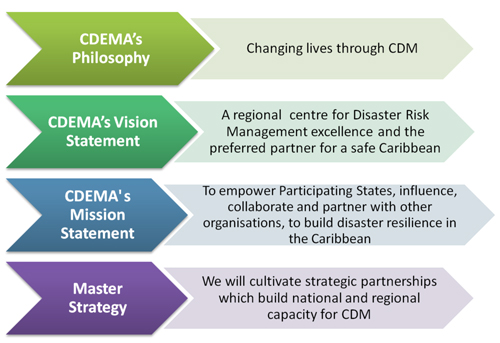
PHILOSOPHY, MISSION, VISION AND MASTER STRATEGY OF THE CDEMA COORDINATING UNIT
{slider title="Project Overview" open="true" class="icon"}
Throughout the Caribbean region, the education sector is highly vulnerable to the range of natural hazards that threaten its countries. Over the last two decades, the sector has experienced significant damage and losses due to the impact of natural hazards. The passage of Hurricane Ivan on 7 September, 2004—what can be considered to be a landmark event in the history of Grenada—resulted in damage to 75 of the 78 schools on the island, disrupting their operations for up to three months (The World Bank, 2005). More recently, the passage of Hurricane Maria on 18 September 2017 wreaked havoc on the entire island of Dominica, flattening schools and leaving more than a third of government-owned schools out of operation even two months after the initial impact (United Nations, 2017). The threat that accelerated climate change poses to the increased frequency and intensity of such hydro-meteorological hazards is expected to have a direct bearing on the education sector.
On July 20, 2017, the Caribbean Development Bank (CDB) approved grant funding of EUR 746,000 to the Caribbean Disaster Emergency Management Agency Coordinating Unit (CDEMA- CU) to further implement the Model Safe School Programme (MSSP) toolkit in four CDB Borrowing Member Countries (BMCs): Antigua and Barbuda, Dominica, St. Kitts and Nevis and St. Lucia. In order to address some of the evident vulnerabilities of the education sector, the toolkit was developed by CDEMA to guide governments on the development of National Safe School Policies, and to offer tools for assessing the level of safety and greening of schools.
{/sliders}
{slider title="Project Components" open="false" class="icon"}
The implementation of the Model Safe School Programme in the Caribbean (MSSP) was designed to, among other things, enhance the capacity of Antigua and Barbuda, Dominica, St. Kitts and Nevis and St. Lucia to incorporate and mainstream comprehensive risk and disaster management considerations in education sector policies, planning and operations.
The Project components consist of:
- converting the existing paper-based MSSP tool to an electronic format and testing the electronic tool;
- reviewing, elaborating and enhancing the building condition assessment element of the MSSP tool-kit and to provide training for assessors in four CDB Borrowing Member Countries (BMCs);
- developing/enhancing national socially and gender-inclusive policies on school safety, delivering training of trainers/assessors on the tools and standards for school safety, conducting hazard risk assessments in 31 schools on the four selected BMCs; and preparing individual costed action plans for reducing or eliminating the risks identified during the school assessments;
- supporting project management and project visibility actions in four BMCs.
{/sliders}
{slider title="Funding and Implementing Partners" open="false" class="icon"}
The project will be executed by CDEMA through its Coordinating Unit. The project will be implemented in collaboration with the Ministries of Education and the Ministries of Public Works or the agency responsible for school construction and maintenance, school administration and the National Disaster Management Office (NDMO) in each country. Project execution is expected to last a period of 24 months.
Funding is being provided under the African Caribbean Pacific-European Union-Caribbean Development Bank Natural Disaster Risk Management (ACP-EU-CDB NDRM) in CARIFORUM Countries Programme.
{/sliders}
{slider title="References" open="false" class="icon"}
- The World Bank Latin America and the Caribbean Hazards Risk Management Unit. 2005. Grenada: a National Rebuilding- An Assessment of the reconstruction and economic recovery one year after Hurricane Ivan. http://siteresources.worldbank.org/INTDISMGMT/Resources/grenanda_rebuilding.pdf
- United Nations. 2017. Dominica: Hurricane Maria Situation Report No. 11 (as of 16 November 2017).
https://reliefweb.int/sites/reliefweb.int/files/resources/20171711_situational_report_no.11_final.pdf
{/sliders}
Early Warning Systems (EWS) Project
{slider title="Project #1: Strengthening integrated early warning systems for more effective disaster risk reduction in the Caribbean through knowledge and the transfer of tools" open="true" class="icon"}
"Strengthening integrated early warning systems for more effective disaster risk reduction in the Caribbean through knowledge and the transfer of tools" is a Disaster Risk Reduction project of the DIPECHO Action Plan for the Caribbean, implemented by the United Nations Development Program (UNDP), the Caribbean Disaster Emergency Management Agency (CDEMA), and the International Federation of the Red Cross and the Red Crescent (IFRC), and funded by the General Directorate of Civil Protection and Humanitarian Aid of the European Union (ECHO).
This project, which is being implemented in Antigua and Barbuda, Dominica, the Dominican Republic, Haiti, Saint Lucia, Saint Vincent and the Grenadines and Cuba over an 18-month period, seeks to strengthen disaster preparedness and risk reduction through Integrated Early Warning Systems (EWS). Working in this important element for disaster risk reduction, is expected to enhance the prevention, mitigation and response capacities at both the institutional and community level, based on mutual learning and collaboration between countries and regional institutions working in disaster risk reduction across the Caribbean.
*Any additional basic and validated project information can be found in the project brochure.
{slider title="Spanish" open ="false" class="icon"}
"Fortaleciendo los sistemas integrados de alerta temprana para una reducción más efectiva del riesgo de desastres en el Caribe a través del conocimiento y la transferencia de herramientas", es un proyecto de Reducción de Riesgo de Desastres del Plan de Acción DIPECHO para el Caribe, implementado por el Programa de las Naciones Unidas para el Desarrollo (PNUD), la Federación Internacional de la Cruz Roja y la Media Luna Roja (FICR) y la Agencia de Gestión de Emergencias del Desastre del Caribe (CDEMA) y auspiciado por la Dirección General de Protección Civil y Ayuda Humanitaria de la Unión Europea (ECHO).
Este proyecto, que se desarrolla en Antigua y Barbuda, Dominica, República Dominicana, Haití, Santa Lucia, San Vicente y las Granadinas y Cuba en un periodo de 18 meses, busca fortalecer los Sistemas Integrados de Alerta Temprana (SAT). A través del trabajo sobre este elemento importante de la reducción del riesgo de desastres, se espera mejorar las capacidades de prevención, mitigación y respuesta a nivel de las instituciones y las comunidades, basándose en el conocimiento y colaboración mutua entre países e instituciones regionales trabajando en la reducción de riesgos de desastres en toda la región del Caribe.
{/sliders}
{slider title="Important Links" class="icon"}
- EWS Toolkit
- Multi Hazard Early Warning Systems Checklist
- {jd_file file==156}
- {jd_file file==155}
- {jd_file file==154}
{/sliders}
{slider title="Meetings:" open="false" class="icon"}
{/sliders}
{slider title="Project #2: Strengthen integrated and cohesive preparedness capacity at a regional, national and community level in the Caribbean" open="true" class="icon"}
The “Strengthen integrated and cohesive preparedness capacity at a regional, national and community level in the Caribbean” project supports concrete actions for an effective early warning system, as well as aims to improve information management and operational capacity for an improved Caribbean Regional Response Mechanism. Working with Antigua and Barbuda, Dominica, the Dominican Republic, Saint Lucia, Saint Vincent and the Grenadines and Cuba at a national and community level, and with regional early warning and response actors at the Caribbean level, United Nations Development Program (UNDP), the Caribbean Disaster Emergency Management Agency (CDEMA), United Nations Office for the Coordination of Humanitarian Affairs (OCHA), and the International Federation of the Red Cross and the Red Crescent (IFRC) are partnering with the General Directorate of Civil Protection and Humanitarian Aid of the European Union (ECHO) to reduce the risk of disasters in the region.
{slider title="Spanish" open ="false" class="icon"}
El proyecto "Fortalecer la capacidad de preparación integrada y cohesiva a nivel regional, nacional y comunitario en el Caribe" apoya acciones concretas para un sistema eficaz de alerta temprana, así como tiene por objetivo mejorar la gestión de la información y la capacidad operativa para un mejor Mecanismo de Respuesta Regional del Caribe. En colaboración con Antigua y Barbuda, Dominica, la República Dominicana, Santa Lucía, San Vicente y las Granadinas y Cuba a nivel nacional y comunitario, y con los actores regionales de alerta temprana y respuesta a nivel del Caribe, el Programa de las Naciones Unidas para el Desarrollo (PNUD), la Agencia Caribeña para el Manejo de Emergencias por Desastres (CDEMA), La Oficina de Coordinación de Asuntos Humanitarios de las Naciones Unidas (OCHA) y la Federación Internacional de la Cruz Roja y de la Media Luna Roja (FICR) se han asociado con la Dirección General de Protección Civil y Ayuda Humanitaria de la Unión Europea (ECHO) para reducir el riesgo de desastres en la región.
{slider title="Meetings/Workshops" open ="false" class="icon"}
- 2nd Regional Early Warning Systems Consortium Meeting| 31 January, 2019
- Understanding Disaster Risk Management: A One-Day Training Workshop for Media Practitioners| 9 March, 2019
- Project Launch and Promoting DRR and Resilience through Theatre Launch| 12 March, 2019
{/sliders}
{slider title="Project #1: Strengthening integrated early warning systems for more effective disaster risk reduction in the Caribbean through knowledge and the transfer of tools" open="true" class="icon"}
"Strengthening integrated early warning systems for more effective disaster risk reduction in the Caribbean through knowledge and the transfer of tools" is a Disaster Risk Reduction project of the DIPECHO Action Plan for the Caribbean, implemented by the United Nations Development Program (UNDP), the Caribbean Disaster Emergency Management Agency (CDEMA), and the International Federation of the Red Cross and the Red Crescent (IFRC), and funded by the General Directorate of Civil Protection and Humanitarian Aid of the European Union (ECHO).
This project, which is being implemented in Antigua and Barbuda, Dominica, the Dominican Republic, Haiti, Saint Lucia, Saint Vincent and the Grenadines and Cuba over an 18-month period, seeks to strengthen disaster preparedness and risk reduction through Integrated Early Warning Systems (EWS). Working in this important element for disaster risk reduction, is expected to enhance the prevention, mitigation and response capacities at both the institutional and community level, based on mutual learning and collaboration between countries and regional institutions working in disaster risk reduction across the Caribbean.
*Any additional basic and validated project information can be found in the project brochure.
{slider title="Spanish" class="icon"}
"Fortaleciendo los sistemas integrados de alerta temprana para una reducción más efectiva del riesgo de desastres en el Caribe a través del conocimiento y la transferencia de herramientas", es un proyecto de Reducción de Riesgo de Desastres del Plan de Acción DIPECHO para el Caribe, implementado por el Programa de las Naciones Unidas para el Desarrollo (PNUD), la Federación Internacional de la Cruz Roja y la Media Luna Roja (FICR) y la Agencia de Gestión de Emergencias del Desastre del Caribe (CDEMA) y auspiciado por la Dirección General de Protección Civil y Ayuda Humanitaria de la Unión Europea (ECHO).
Este proyecto, que se desarrolla en Antigua y Barbuda, Dominica, República Dominicana, Haití, Santa Lucia, San Vicente y las Granadinas y Cuba en un periodo de 18 meses, busca fortalecer los Sistemas Integrados de Alerta Temprana (SAT). A través del trabajo sobre este elemento importante de la reducción del riesgo de desastres, se espera mejorar las capacidades de prevención, mitigación y respuesta a nivel de las instituciones y las comunidades, basándose en el conocimiento y colaboración mutua entre países e instituciones regionales trabajando en la reducción de riesgos de desastres en toda la región del Caribe.
{slider title="Important Links" class="icon"}
EWS Toolkit
Multi Hazard Early Warning Systems Checklist
- {jd_file file==156}
- {jd_file file==155}
- {jd_file file==154}
{slider title="Meetings:" class="icon"}
- MHEWS: Achievements and Strategic Path Forward - High-Level Handover Meeting 1st, February, 2019
- Joint Meetings for the Regional Validation of the National Model Multi-Hazard Early Warning Systems (MHEWS) Policy 12th – 14th, November, 2019 in Saint Lucia
{/sliders}
{slider title="Project #2: Strengthen integrated and cohesive preparedness capacity at a regional, national and community level in the Caribbean" open="true" class="icon"}
The “Strengthen integrated and cohesive preparedness capacity at a regional, national and community level in the Caribbean” project supports concrete actions for an effective early warning system, as well as aims to improve information management and operational capacity for an improved Caribbean Regional Response Mechanism. Working with Antigua and Barbuda, Dominica, the Dominican Republic, Saint Lucia, Saint Vincent and the Grenadines and Cuba at a national and community level, and with regional early warning and response actors at the Caribbean level, United Nations Development Program (UNDP), the Caribbean Disaster Emergency Management Agency (CDEMA), United Nations Office for the Coordination of Humanitarian Affairs (OCHA), and the International Federation of the Red Cross and the Red Crescent (IFRC) are partnering with the General Directorate of Civil Protection and Humanitarian Aid of the European Union (ECHO) to reduce the risk of disasters in the region.
{slider title="Spanish" class="icon"}
El proyecto "Fortalecer la capacidad de preparación integrada y cohesiva a nivel regional, nacional y comunitario en el Caribe" apoya acciones concretas para un sistema eficaz de alerta temprana, así como tiene por objetivo mejorar la gestión de la información y la capacidad operativa para un mejor Mecanismo de Respuesta Regional del Caribe. En colaboración con Antigua y Barbuda, Dominica, la República Dominicana, Santa Lucía, San Vicente y las Granadinas y Cuba a nivel nacional y comunitario, y con los actores regionales de alerta temprana y respuesta a nivel del Caribe, el Programa de las Naciones Unidas para el Desarrollo (PNUD), la Agencia Caribeña para el Manejo de Emergencias por Desastres (CDEMA), La Oficina de Coordinación de Asuntos Humanitarios de las Naciones Unidas (OCHA) y la Federación Internacional de la Cruz Roja y de la Media Luna Roja (FICR) se han asociado con la Dirección General de Protección Civil y Ayuda Humanitaria de la Unión Europea (ECHO) para reducir el riesgo de desastres en la región.
{slider title="Meetings/Workshops" class="icon"}
- 2nd Regional Early Warning Systems Consortium Meeting| 31 January, 2019
- Understanding Disaster Risk Management: A One-Day Training Workshop for Media Practitioners| 9 March, 2019
- Project Launch and Promoting DRR and Resilience through Theatre Launch| 12 March, 2019
{/sliders}
{slider title="Caribbean Safe School Programme (CSSP)" open="true" class="icon"}
In 2015, the CDEMA Council of Ministers endorsed the CDEMA Model School Safety Programme (MSSP) as the Caribbean approach to comprehensive risk management in schools. The MSSP is congruent with international approaches to school safety, particularly the Comprehensive School Safety (CSS) framework. The MSSP goes further than the broad outline of the CSS to articulate a suite of standards for school safety and a system for institutionalizing school safety through the implementation of school safety policies and procedures including a certification process. The CDEMA CU has been working to develop partnerships that will support adaptation of the MSSP at the national level.
{/sliders}
{slider title="Caribbean Safe School Ministerial Forum" open="false" class="icon"}
The Caribbean Safe School Ministerial Forum (CSSF) was hosted by the Ministry of Education, Science and Technology of Antigua and Barbuda from 3-4 April, 2017 in Antigua. This Forum was organized by the United Nations Office for Disaster Risk Reduction (UNISDR), and the Caribbean Disaster Emergency Management Agency (CDEMA) in close collaboration with the Ministry of Education, Science and Technology of Antigua and Barbuda, the United Nations International Children's Emergency Fund (UNICEF), United Nations Educational, Scientific and Cultural Organization (UNESCO) and International Federation of Red Cross and Red Crescent Societies (IFRC).
The Forum targeted Ministries of Education - Ministers as well as technical advisors - and aimed to articulate a ministerial Declaration on School Safety. Regional and international partners, that can support the implementation of School Safety in the Caribbean, were also invited to participate. The two-day workshop presented achievements regarding school safety at the national as well as regional level. Based on national needs and gaps, priorities were identified to a Caribbean roadmap. The Forum was the first step in the launch of the Caribbean School Safety Initiative. The CDEMA Model School Safety Programme was presented as the vehicle through which countries can advance the Caribbean School Safety Initiative.
{/sliders}
{slider title="Important Links" open="false" class="icon"}
- Model Safe School Programme in the Caribbean Project
- Antigua and Barbuda Declaration School Safety in the Caribbean
- Caribbean Road Map on School Safety
{/sliders}
{slider title="Background" open="true" class="icon"}
The CDEMA Council of Ministers, in June 2013, endorsed the establishment of a Regional Training Centre (RTC) that will set standards and build capacity for Comprehensive Disaster Management through a multi-stakeholder, collaboration and engagement.
{/sliders}
{slider title="Purpose & Role Of The RTC" open="false" class="icon"}
The Agreement Establishing CDEMA mandates the Coordinating Unit to build and maintain required capabilities for CDM in the CDEMA system. The RTC is a mechanism for meeting this mandate, setting the standards for these capabilities, identifying capacity building needs among constituents and delivering training programmes that will address these needs.
Specifically the RTC will:
- Promote Comprehensive Disaster Management (CDM)
- Establish standards for CDM capabilities
- Identify gaps in CDM capabilities and training needs within the CDEMA system
- Develop and maintain the capabilities for CDM through the provision of a programme of standardised training
- Maintain a repository of resources to support capacity building
- Maintain a record of existing capabilities, materials and resources
- Monitor and evaluate the effectiveness of capacity building initiatives within the system
- Promote innovation in CDM
- Facilitate and promote partnerships for development and delivery of standardised training for CDM
{/sliders}
{slider title="Training Programmes" open="false" class="icon"}
The core programme areas for the RTC are:
- Emergency Operations and Contingency Planning
- Disaster Risk Management (Introductory)
- Programme Development and Management for CDM.
Training programmes are also offered in collaboration with regional and international partners covering courses in DRM. Please go to “Training Programmes” to find out more about our offerings. The catalogue of course offerings is under constant development and will be expanded over the next four years.
{/sliders}
{slider title="Beneficiaries" open="false" class="icon"}
The primary beneficiaries include CDEMA Participating States particularly actors in the National Disaster Organisations, staff of the Coordinating Unit and DRM partners. These groups will benefit directly from the articulation and development of training and competency standards, capacity building interventions, training programmes and materials. Private sector agencies and individuals may also benefit from access to training at a cost. Secondary beneficiaries will be the communities in CDEMA countries that receive training from professionals that have gained skills and knowledge through the RTC standardised training programme.
{/sliders}
{slider title="Facilities" open="false" class="icon"}
Delivery of training at the RTC is flexible and responsive, recognising the unique needs and characteristics of beneficiaries. The RTC delivers traditional, classroom-style training both at the CDEMA HQ in Barbados and off-site in any CDEMA Participating State. The Centre also delivers online training though its DigitalChalk Learning Management System (LMS); blended training options can be designed.
{/sliders}
{slider title="Guiding Principles & Values" open="false" class="icon"}

{/sliders}
{slider title="Important Links" open="false" class="icon"}
IMPORTANT LINKS
Introduction to Comprehensive Disaster Management in the Caribbean
{/sliders}
See also : Hurricane tips for Businesses | Hurricane tips for Home
DEFINITION
A hurricane is a tropical cyclone (see below) in which the maximum average wind speed near a centre or eye exceeds 74 mph or 119 Km/h. The winds rotate in a counter-clockwise spiral around a region of low pressure. In the Atlantic and Eastern Pacific such systems are they are called HURRICANES. In the Western Pacific, including the Philippines - TYPHOONS, near Australia - WILLY WILLY and in the Indian Ocean - CYCLONES. The tropical cyclones are given names for easier identification and tracking.
FORMATION AND INITIAL DEVELOPMENT STAGES OF TROPICAL CYCLONES
Tropical cyclone is the generic term used by the World Meteorological Organisation to define weather systems developing over tropical or subtropical waters in which winds exceed 34 knots or 63 km/h. Tropical cyclones also have a definite organised surface circulation.
Four conditions are necessary for the development of a tropical cyclone:
- A warm sea temperature in excess of 26 degrees Celsius or 79 degrees Fahrenheit.
- High relative humidity (degree to which air is saturated by vapour).
- Atmospheric instability.
- A location of at least 4 - 5 latitude degrees from the Equator.
PHASES
There are four phases of development which are linked to to the associated wind intensities:
- Tropical Disturbance
A weather system which gives rise to a specific area of cloudiness with embedded showers and thunderstorms. - Tropical Depression
A tropical cyclone system with definite counter-clockwise wind circulation with maximum sustained winds of less than 38 mph (61 km/h). At this stage the system is given a number. - Tropical Storm
A tropical cyclone system, with maximum sustained surface winds greater than 38 mph (61 km/h), but less than 74 mph (119 km/h). At this stage the system is given a name. - Hurricane
A tropical cyclone with wind speed greater than 74 mph (119 km/h). The weather system is now better organised and the eye is well defined.
CLASSIFICATION OF HURRICANES
The Saffir Simpson Scale is used to classify Hurricanes according to intensity. In this scale, hurricanes are classified into one of five categories as shown below.
|
Category
|
Central Pressure
Mean (millibars) |
Winds mph
(km/h) |
Surge (ft)
|
Damage
|
Example of a Storm
|
| 1 | 980 or more | 74 - 95mph (119 - 151km/h) | 4-5 | Minimal | Lili 2002 |
| 2 | 965 - 979 | 96 - 110mph (152 - 176km/h) | 6-8 | Moderate | Isabel 2003 |
| 3 | 945 - 964 | 111-129mph (177 - 209km/h) | 9-12 | Extensive | Katrina 2005 |
| 4 | 920 - 944 | 130 - 156mph (210 - 248km/h) | 13-18 | Extreme | Charley 2004 |
| 5 | less than 920 | more than 157mph (248km/h) | more than 18 | Catastrophic | Gilbert 1988 |
CHARACTERISTICS
Tropical cyclones are characterised by their destructive winds, storm surges and exceptional levels of rainfall which may cause flooding.
Destructive Winds
The strong winds generated by Tropical cyclones circulate clockwise in the Southern Hemisphere and counter clockwise in the Northern Hemisphere while spiraling inward and moving towards the cyclone centre. Winds speeds progressively increase towards the core. As the eye arrives, winds fall off to become almost calm but rise again just as quickly as the eye passes and are replaced by hurricane force winds from a direction nearly the reverse of those previously blowing.
Storm Surges
The rise in sea level above the normal tide. (See Table for Saffir-Simpson Scale). As the cyclone approaches the coast, the friction of strong on-shore winds on the sea surface, plus the "suction effect" of reduced atmospheric pressure, can pile up sea water along a coastline near a cyclone's landfall well above the predicted tide level.
Excessive Rainfall
The high humidity condenses into rain and giant cumulus clouds result in high precipitation rates when the cyclone reaches land. The rain rapidly saturates the ground and rapid run off will result in severe flooding.
LIKELY IMPACT
Physical Damage
 Structures will be damaged or destroyed by wind force, storm surges, landslides and flooding. Public utilities such as overhead power lines, water and gas distribution lines, bridges, culverts and drainage systems are also subject to severe damage. Fallen trees, wind driven rain and flying debris can also cause considerable damage.
Crops and Food Supplies
The combination of high winds and heavy rain and flooding can ruin crops and trees. Food stocks may be lost or contaminated and it is possible that food
shortages will occur.
Casualties and Public Health
 There are relatively few deaths associated with the impact of high winds. However, storm surges may cause many deaths but usually few injuries among survivors. The threat to public health emerges in the aftermath of events when conditions such as water contamination or shortages, flooding and damage to sanitation facilities may favour the spread of diseases.
Lack of Communication
Communication may be severely disrupted as telephone lines, radio and television antennas and satellite disks are blown down. Roads and railway lines may be blocked by fallen trees or debris and aircraft movements are curtailed for hours after a cyclone.
EMERGENCY ACTION
WEATHER WARNINGS - Who Warns?
The local Meteorological Service, the National Disaster Organisation in association with the National Broadcast Media.
ADVISORIES
(Messages issued by the authorities warning about the formation and development of tropical cyclones.) These are usually issued at 0600 AST, 1200 Noon, 1800 AST and 1200 midnight by the National Meteorological Service via the Electronic Media. (AST - Atlantic Standard Time is the same time zone as "Eastern Caribbean Time") Information Includes:
- Name, Date and Time of Fix (reported location)
- Location (relative distance from prominent place).
- Coordinates (latitude and longitude).
- Maximum winds.
- Movement (direction and speed).
- Forecast position.
- Precautionary information.
- Time of next issuance.
Types of Advisories include:
- Tropical Depression Advisory
Provides information on the development and threat of a Tropical Depression which becomes a threat to land. The system is not named unless it is a Hurricane or Tropical Storm which has been down-graded to a Tropical Depression. Each new tropical depression is assigned a number, however. - Tropical Storm Advisory
Issued when the wind speed of a tropical cyclone reaches 39 mph (63 km/h) or higher. Tropical Storms are given names. - Hurricane Watch
Advisory issued for a particular area when conditions are favourable for the development of a hurricane. It does not necessarily mean that a hurricane is imminent. Hurricane watches will be issued when Hurricane conditions are possible along the coast within 48 hours (instead of 36 hours which was previously used). - Hurricane Warning
Issued when hurricane conditions are expected to affect a particular area within 36 hours (instead of 24 hours).
PRECAUTIONARY MEASURES
On Hearing Advisory 
- Continue normal activities but stay tuned to radio and television for further messages.
Hurricane or Tropical Storm Watch
- Review emergency preparedness requirements, especially family emergency plans.
- Continue to listen to weather advisories on radio.
- Be ready to take quick action in case of a Warning.
- Establish contact points.
Hurricane or Tropical Storm Warning
- Stay tuned to the radio for information.
- Protect property and personal possessions (including important documents).
- Place indoors, loose objects found in and around the yard.
- Fill up car with gasoline.
- Pick fruit and trim trees if near house.
- Store water, food and essential medicines.
- Feed animals and pets and move indoors or loose.
- Know where you are going to shelter if the need arises.
After the Hurricane (or Tropical Storm)
-
Assist in search and rescue.
-
Seek medical attention for persons injured.
-
Clean up debris and effect temporary repairs.
-
Report damage to utilities.
-
Assist in road clearance.
-
Watch out for secondary hazards, fire, flooding, etc.
-
Assist in community response efforts.
-
Avoid sightseeing.
-
Co-operate with Damage Assessors.
Note: Additional precautions are available from the local National Disaster Office
PREVENTION AND MITIGATION MEASURES
Risk Assessment
The evaluation of risks of tropical cyclones should be undertaken and illustrated in a hazard map. The following information may be used to estimate the probability of cyclones which may strike a country.
-
Analysis of climatological records to determine how often cyclones have struck, their intensity and locations.
-
History of winds speeds, frequencies of flooding, height location or storm surges.
-
Information about 50-100 years cyclone activity.
Land Use Control
This is designed to control land use so that the least critical facilities are placed in most vulnerable areas. Policies regarding future development may regulate land use and enforce building codes for areas vulnerable to the effects of tropical cyclones.
Flood Plain Management
A master plan for flood plain management should be developed to protect critical assets from flash, riverine and coastal flooding.
Reducing Vulnerability of Structures and Infrastructures
-
New buildings should be designed to be wind and water resistant. Design standards are usually contained in Building codes.
-
Communication and utility lines should be located away from the coastal area or installed underground.
-
Improvement of building sites by raising the ground level to protect against flood and storm surges.
-
Protective river embankments, levees and coastal dikes should be regularly inspected for breaches due erosion and opportunities taken to plant mangroves to reduce breaking wave energy.
-
Improved vegetation cover. This helps to reduce the impact of soil erosion and landslides and facilitates the absorption of rainfall to reduce flooding.
See also : Hurricane tips for Homes | Fact Sheet on Tropical Weather Systems

Hurricane Preparedness Tips for Businesses
Have you ever considered the catastrophic effects a hurricane may have on your business, your employees and your life?
DEVELOP A WRITTEN PLAN
Developing a written preparedness plan and training employees to implement it is critical. The following guidelines are provided to assist you in the development of your plan.
When you develop your written plan, make sure to address the following major areas:
- Make plans for the protection of plant and equipment.
- Develop a staffing policy that identifies essential employees and which of them, if any, must remain at the facility during the hurricane. The policy should identify when employees will be released from work as well as when they are expected to return. Businesses may predetermine that employees will return to work when employees are ordered to return, in case telephone service is out.
- Develop procedures and policies for all phases of hurricane operations:
- Pre-Season Preparedness
- Hurricane Watch
- Hurricane Warning
- After the Hurricane
- Identify and protect vital records such as accounts receivable, customer records, tax records, and other personnel and administrative documents.
- Review insurance policies to ensure that there is adequate coverage.
Questions to ask include:
- Is the facility in a high hazard, evacuation area?
- Does the insurance package include wind/storm coverage?
- Is the facility located in a flood prone area and is the flood insurance adequate?
- Does insurance cover damage to contents, including vital records and office equipment?
- Does the package include liability coverage for injury to employees as well as potential lawsuits from customers?
BEFORE
- Compile an Emergency Contact List with 24-hour telephone contact numbers of essential employees.
- Identify vital records and make back-up copies/and or transfer them to microfilm. Identify a safe storage level area within the facility where records can be relocated, if necessary. This area should be above ground level and away from windows and exterior walls, which may leak. In a one-story facility, file cabinets and boxes may be placed on pallets up off the floor. Consider moving vital records off-site, particularly if the business is in a storm-surge vulnerable area.
- Determine responsibility for maintaining the facility. Ensure that the following items are addressed:
- Patch roofs and windows.
- Check security and flood lighting.
- Identify lightweight, loose items in outside storage areas that may be blown around in the wind.
- Identify emergency power requirements and determine if generator is available. If facility must be operational during a hurricane and a generator is not available, rent or purchase a generator. Test generator monthly during the hurricane season.
- Determine if computer support will be available for primary/ critical computer users who need to remain operational during a hurricane.
- Verify that communications equipment is operational.
- Determine the type and amount of hurricane emergency supplies necessary. All hurricane emergency supplies should be clearly marked and stored in a secure area that is accessible in an emergency. Recommended supplies include:
- A battery-operated radio or TV (test reception in building).
- One flashlight per person working during the hurricane.
- Extra batteries for both radio and flashlights.
- First-Aid kit.
- Emergency tool kit, if necessary.
- Food and water supplies for staff assigned to the facility during the hurricane. Be sure to include needed utensils.
- Provide employees with hurricane preparedness information.
HURRICANE WATCH
- Secure all doors, windows, and other openings against wind and water.
- Tie down or bring indoors any objects which may be blown about by hurricane winds. Install hurricane shutters, cover windows with boards, or close drapes. If a room must be occupied during the hurricane and window protection is not available, windows may be crisscrossed with tape to slightly reduce flying glass.
- Verify that vital records are in a safe storage area. Files, records, and storage cabinets may be wrapped in plastic for moisture protection. If necessary, temporarily relocate records to a safe storage facility off-site.
- Confirm availability of necessary computer support.
- Ensure that all vehicles are serviced and fueled. Determine where they can be stored to safely weather the storm.
- Inventory hurricane emergency supplies and restock if necessary.
- Dismiss essential employees temporarily so they can secure their personal property before returning to duty.
HURRICANE WARNING
- Move desks, files, equipment and furniture away from un-shuttered windows. Papers, drawings, etc. should be placed inside files or desks. Wrap office equipment, such as copy machine and computers, in plastic to protect against water damage.
- Dismiss all non-essential personnel.
- Turn off all air conditioners, disconnect electrical equipment, turn off lights.
AFTER THE HURRICANE
- Assess basic damages at work site including roof, water, damage and broken windows.
- Initiate clean-up of work-site.
- Do not turn on computer equipment if there are indications of low voltage power fluctuations, low air conditioning output, water under raised floor, broken windows or damaged equipment.
- Employees return to work according to staffing schedule.